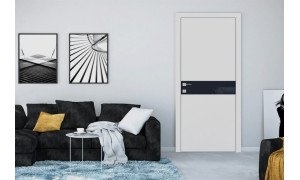
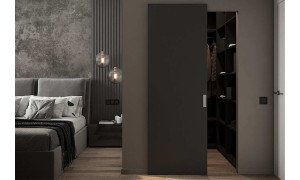
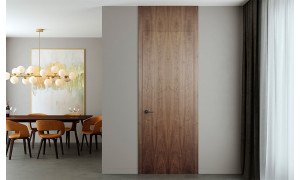
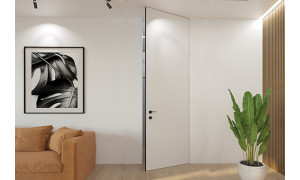
Design your living space with sliding doors and room dividers.
Not only can doors be used to transform and zone your room's interior, but sliding systems have gained great popularity for designing a modern living space. These systems can help to divide your room into functional zones, facilitate the transition from one room to another, and separate living space from the hall and kitchen. The application of sliding systems in your interior not only saves space but also makes your living space unique.
Types of sliding room dividers: from immemorial times to the present day
Since ancient times in Japan, two types of dividers have been used to define living space. The fusuma is an opaque sliding panel that serves to define the space in the washitsu rooms of Japanese houses. It can serve as both a door and a wall. The shoji (transparent sliding panel) is used to separate the exterior and interior of the house.
In the beginning of the twentieth century, the Japanese trend was commonly used in the USA and then expanded throughout the world. At present, modern masters create beautiful, functional dividers of four types where the dividing panel is moving: along the wall in the visible guide, can have from one to several panels moving softly and silently; in a hidden track, dividers flow like air trucks that are hidden when dividers are open or closed. Can only be single leaf or bivalve; inside the opening-multi folding (up to six panels) system with visible or hidden track; inside of wall case-design which provides maximal space saving. Doors are opening to the side and moving to the special place inside the wall. This allows us to use the space beside the divider for your room furniture.
- A great design idea- sliding panel instead of the room door.
- Although sliding doors and panels can be made in different styles, the most common ones are:
- Loft-deliberately rough metal or aluminium frame in black (rarely white) colour in simple geometric figures of different sizes. Panels made from glass (triplex) can be combined with wood panels.
- Classic- panels made from valuable wood species or MDF without décor, creating a surface similar to traditional doors.
- Art-deco industrial-metal frame with mirror-like or matte glass, with sandblasting abstract drawing.
- Minimalistic- these models successfully combine structured and light plastic with black glass or fully transparent frameless construction.
- Country-natural wooden frame or metal mouldings harmoniously combined with transparent glass.
You can easily find sliding panels from a big variety having decided the type of openings and design. Any system can help you adapt your living space: either make your space open or divide it into rooms.
Advice: The main factors to consider in the selection process are: Mechanism – unlike a wardrobe, the most popular styles have no bottom track. Opening size- if you have a narrow opening better choose a style with one panel, if you have a wide opening (2-3 metres) a style with two or three panels is recommended, because the maximum width of a single panel is limited for safety purposes. Material type- since glass models are the most popular, please make sure that they are made from impact-resistant tempered glass or triplex. Besides, framed types are more reliable and safer. Accessories - minimum set (rollers, top and bottom tracks), soft closer (for smooth closing and shock protection), synchronizer (for the comfortable opening of several panels), handle with a lock or without.
The final price depends on the type of materials, sizes, and type of the construction, mechanisms, and accessories used and additional options. For proper installation, it is worth inviting our specialist who will take measurements correctly and determine how much space is needed for installation.