.jpeg)
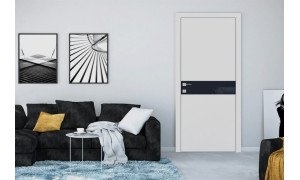
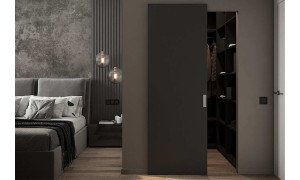
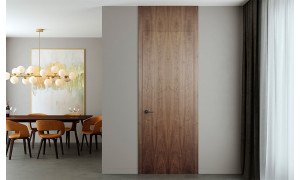
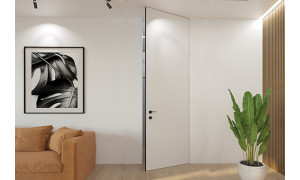
A concealed door with wall panels can highlight the interior of an apartment or country cottage. This variant of finishing the front door leaf will allow the construction to completely dissolve in the room's space and become as invisible as possible. Thanks to the variety of textures and textures of panels, truly unique projects are created.
Advantages of concealed doors and their finishing options
Functional, practical and unusual hidden door designs have gained worldwide popularity due to such advantages:
- ability to visually expand space;
- ergonomics and space-saving;
- the ability to disguise the entrance to a bedroom, dressing room, or any other room (casings and jambs are invisible);
- a practically endless number of decoration options;
- an ideal solution for non-standard doorways.
Two trends are expected in interior design: complete merging of doors with walls and accentuating the design. The first option implies concealed doors with panelling:
- pre-painted - a classic method, the walls and doors are painted with the same colour;
- wood veneer - cladding of the concealed door with veneer panels is performed if the designer is tasked with creating a continuous wooden wall inside the room;
- wallpaper - a correctly selected pattern guarantees a holistic perception of the space.
Using bright wallpaper, decorative plaster, mosaics, decoupage, or coloured volumetric stickers can create a noticeable interior accent. One of the most modern trends is feather-style walls, and feathers can be bright or restrained, realistic or stylized.
Types of wall panels
Thinking about how to hide the invisible door with the help of panels, the first thing to do is pay attention to the latter varieties. They are flat or volumetric and are made of:
- plastic (PVC) - hygienic, water-resistant, easy to install and operate, ideal for rooms with high humidity;
- wood boards (fiberboard, chipboard, MDF) - moisture-resistant, dense, environmentally friendly and durable;
- gypsum vinyl - ordinary gypsum board is covered with cardboard and laminated on both sides with hard PVC film with any texture on the front surface;
- wood is a traditional, environmentally friendly material treated with oil, varnish, or wax.
Are you not sure how to combine concealed doors with wall panels to create the illusion of a single wall covering? Choose tight-fitting elements that are completely smooth or resemble stone, brick, or wood in any shade, from a soft, light beige tone to white, black, or bright red.
Door construction options
First, doors are classified by the number of sashes on single-leaf and double-leaf (much rarer are products with many blades). And by opening invisible doors are:
- swing - ordinary, familiar to all doors without a frame, opening away or towards themselves;
- pocket - when opened, the doors slide into a special frame on the side located inside the wall;
- barn - this is a wall-mounted sliding door with a visible roller mechanism and rail;
- pivot - turn around their axis on hinges, do not have protruding hardware;
Installation of a concealed door with wall panels
The main rule is to engage in installation work at the stage of rough repair. First, the aperture is prepared, then the design is installed in the assembly. After that, the door slab is removed from the hinges for finishing, fastened to the hinges, and the hardware is installed and adjusted.
Before concealing the invisible door with panels with ornaments or patterns, make sure they match perfectly. If necessary, purchase one or two panels to fit the pattern. Buying panels with a solid-coloured background will save you a lot of headaches.